How AI Is Changing the Future of Digital Marketing
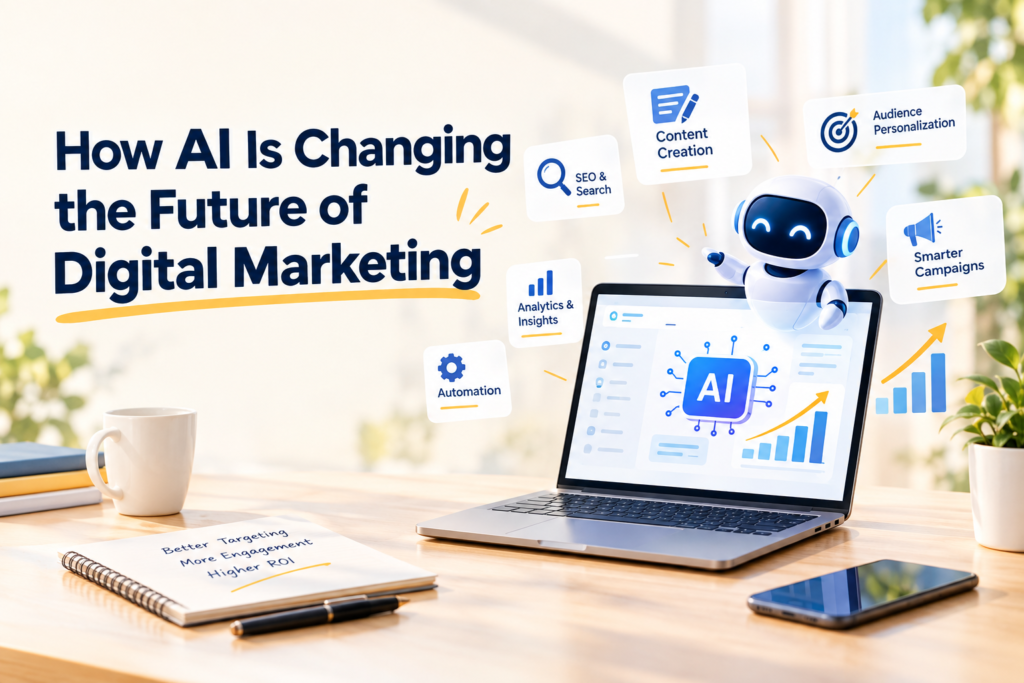
How AI Is Changing the Future of Digital Marketing Digital marketing is going through one of its biggest shifts in years, and artificial intelligence sits right at the center of it. Businesses across every industry are automating, personalising, and moving faster than ever before because of what AI now makes possible. AI is no longer a side tool for marketers, it has become the infrastructure that campaigns run on. AI Is Now Running the Campaigns A few years ago, AI in marketing meant simple automation like scheduling posts or basic chatbots, but that has changed completely. Platforms like Google’s Performance Max, Meta’s Advantage+ Shopping Campaigns, and LinkedIn’s AI optimised campaigns now handle bidding, placement, audience targeting, and even creative combinations on their own. Brands that win today are the ones that feed these systems high quality data and clear goals, rather than trying to control every small setting manually. This shift means marketers are spending less time on manual adjustments and more time on strategy, messaging, and understanding what actually drives results. Search Is Moving Away From Keywords For over a decade, ranking on Google meant chasing the right keywords, but that model is fading fast because of AI powered search. Search is moving from keyword matching toward answer generation, where tools give users a direct AI written response instead of a list of links. Brands now need to think about Generative Engine Optimisation, making sure their content gets picked up and quoted by AI systems rather than just ranked on a results page. This is a major change in how visibility works online, and businesses that ignore it risk becoming invisible in AI generated answers. Personalisation at a Scale Humans Cannot Match AI has made real time personalisation possible in a way that was never achievable manually. Predictive analytics now studies browsing patterns, past purchases, and even the time a person is most active online to deliver content that feels tailor made. Product recommendations, email timing, and ad creative can all shift automatically based on what a specific user is likely to respond to. For brands dealing with large and diverse customer bases spread across regions and interests, this level of personalisation was simply not possible before AI took over these decisions. Content Creation Gets Faster and More Scalable AI writing and design tools have changed how quickly brands can produce marketing material. Draft copy, image variations, and video edits that once took days can now be generated in minutes, giving marketing teams more room to test different ideas before committing budget to one direction. Creators are also using AI tools to script, edit, and caption content faster, letting smaller teams produce at a scale that used to require a full production house. AI Agents Working Quietly in the Background A newer trend gaining ground is the rise of AI agents that run marketing operations without needing constant human input. These agents handle tasks like reporting, budget shifting between campaigns, customer segmentation, and even first response customer support, working continuously in the background and adjusting strategy in real time rather than waiting for a weekly review. This frees up marketing teams to focus on bigger creative and strategic decisions instead of routine operational work. Human Creativity Becomes More Valuable, Not Less There is a common fear that AI will replace marketers, but the reality looks different. As AI generated content becomes easier to produce and more common everywhere, audiences are starting to value original, human led creativity even more. Real stories, authentic voices, and genuine brand personality stand out precisely because so much AI content looks and sounds similar. The brands that combine AI efficiency with strong human creative direction are the ones building the strongest connections with their audience. Privacy Rules Are Reshaping How AI Can Be Used AI runs on data, and data privacy rules around the world are tightening. New regulations are forcing brands to rethink how they collect, store, and use customer information for targeting and measurement, meaning marketers can no longer rely on the loose data practices of the past. Instead, brands need to build first party data systems and get clear customer consent before feeding information into AI powered targeting tools. This shift protects users while also pushing brands toward more ethical and sustainable marketing practices. AI and Commerce Are Merging Into One Experience The line between advertising and actual buying is disappearing fast, and AI is the reason why. Product discovery, ads, and purchase are increasingly happening in the same moment, on the same screen, powered by AI recommendation engines. A user scrolling through social media can now see a product, get a personalised offer, and complete the purchase within minutes. This tightening loop between media and retail is becoming one of the biggest growth channels for brands selling online. What This Means Going Forward AI is not just changing individual marketing tasks, it is changing the entire structure of how digital marketing works. Campaign management, search visibility, personalisation, content creation, and even privacy compliance are all being reshaped by AI at the same time. The brands that succeed in this new environment will be the ones that treat AI as a partner rather than a replacement, combining AI’s speed and scale with strong human judgment, authentic storytelling, and ethical data practices to define who wins the next phase of digital marketing.